
 English

 English
Views: 601 Author: Site Editor Publish Time: 2021-12-07 Origin: Site

Symbol Principles of Seven Hydraulic Valves for Recognition of Hydraulic Graphic Symbols
Manual valve
Manual valve has manual positioning and manual resetting. This is very important. Manual resetting means that after the hand is pushed over and released, the handle will automatically bounce back, and the positioning will make the handle stuck in one position.
The electromagnetic valve
The solenoid valve is a combination of an electromagnet and a reversing valve. The electromagnet makes the valve core move through electromagnetic action. Some electromagnets are called proportional electromagnets. This electromagnet can make the valve core move a distance according to a certain proportion, so that it can be precise Control the flow of the reversing valve. Such valves are called proportional valves. Proportional valves and servo valves have been the hot spots in recent years.
With the advancement of industry, the requirements for precise control are getting higher and higher. The proportional valve can be accurately controlled. The parameters of the system control the speed and displacement of the system to meet people's design requirements, making the operation of the equipment more intelligent and precise.
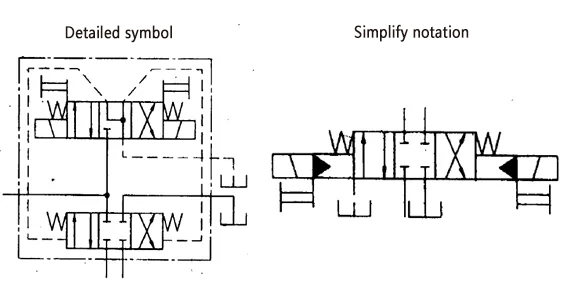
Let’s look at the symbol of this solenoid valve. The oblique line in this rectangular box represents the solenoid operation mode. This symbol is the solenoid valve, and the detailed symbol on the left. It can be seen that the solenoid valve is a solenoid valve and an ordinary valve. Combination, the main valve is the following one, the pilot valve is the solenoid valve above, the main valve: three-position, four-way, spring centered, internal pressure control.
Pilot valve: three-position, four-way, spring centered, single-acting solenoid control
With manual emergency device, external oil drain
Multi-way valve
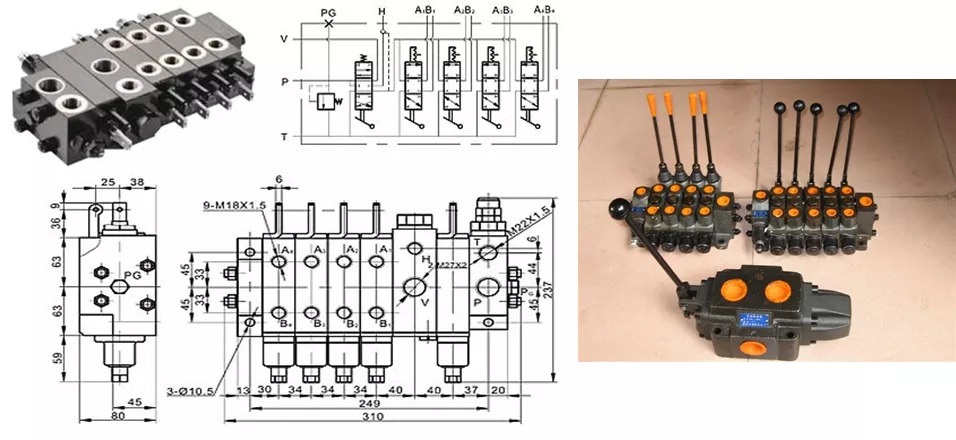
The multi-way valve is a combination of multiple reversing valves, but there is only one oil inlet, one oil drain, and multiple control outlets. There is electromagnetic control. The more common one is manual control. The handle of the multi-way valve can be used. It can be made into a spring return, or it can be made into a spring positioning, according to the demand.
Balance valve
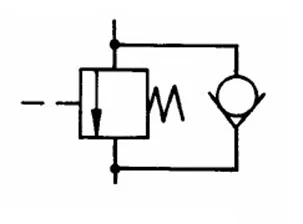
Let's look at the balance valve. The balance valve is a parallel combination of a one-way valve and a sequence valve. When P1 is connected to P2, the one-way valve opens and the sequence valve closes. When P2 leads to P1, the sequence valve opens and the one-way valve closes.
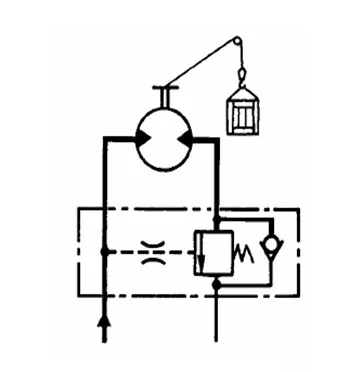
The balance valve is often used to control the circuit of the lifting motor, which can keep the object in the air without slipping, because when the sequence valve is closed, the pressure in the P2 port cannot be released, causing the motor to brake.
When the sequence valve is opened, there is pressure at the P2 port, but it prevents the heavy objects from falling rapidly due to gravity.
